Anatomy and Physiology Honors Chapter 1 the Human Body an Orientation Review
Chapter one The Human being Body: An Orientation Anatomy and Physiology © 2014 Pearson Education, Inc.

Bellwork • On a sheet of newspaper, put todays engagement. Go on this sheet until Friday because you will put each days bellwork on this sheet. Reply the question/statement below. • Define Anatomy and Physiology. • How are construction and function related? Tell me what you already know… © 2014 Pearson Teaching, Inc.

The Educatee Should Be Able To: • Differentiate between Beefcake and Physiology • List necessary life functions (viii) • Listing survival needs (5) • Explain homeostasis and requite examples of types of feedback © 2014 Pearson Educational activity, Inc.

Overview of Anatomy and Physiology • Anatomy • Report of structure and shape of the body parts and their relationships to one another. • "ana"- apart and "tomy" to cut • Subdivisions: • Gross or macroscopic (due east. yard. , regional, systemic, and surface beefcake) • Microscopic (e. chiliad. , cytology and histology) • Developmental (e. g. , embryology) © 2014 Pearson Didactics, Inc.

Overview of Beefcake and Physiology • Study of the function of the body • "physio" nature, "ology" study of • Subdivisions based on organ systems (eastward. m. , renal or cardiovascular physiology) • Oftentimes focuses on cellular and molecular level • Body's abilities depend on chemical reactions in individual cells © 2014 Pearson Education, Inc.

Principle of Complementarity • Anatomy and physiology are inseparable • Function e'er reflects structure • What a construction tin exercise depends on its specific form © 2014 Pearson Education, Inc.

Necessary Life Functions • Maintaining boundaries • Motility • Responsiveness • Digestion • Metabolism • Dispose of wastes • Reproduction • Growth © 2014 Pearson Education, Inc.

Necessary Life Functions • Maintaining boundaries between internal and external environments • Peel • Motility • Includes activities promoted by the muscular system • Aided by the skeletal system © 2014 Pearson Educational activity, Inc.

Necessary Life Functions • Responsiveness • Irritability • Ability to sense changes and answer to stimuli • Nervous system responsible for this office • Digestion • Breakdown of ingested foodstuffs • Absorption of simple molecules into blood © 2014 Pearson Education, Inc.

Necessary Life Functions • Metabolism • All chemic reactions that occur in body cells • Regulated by hormones (where do hormones come up from? ) • Excretion • Removal of wastes from the torso • Urea, carbon dioxide, feces (which systems? ) © 2014 Pearson Education, Inc.

Necessary Life Functions • Reproduction • Cellular partition for growth or repair • Product of offspring • Regulated by hormones • Growth • Increase in size of a torso part or of organism © 2014 Pearson Education, Inc.

Interdependence of Body Cells • Humans are multicellular • To role, must proceed individual cells alive • All cells depend on organ systems to meet their survival needs • All trunk functions spread amid different organ systems • Organ systems cooperate to maintain life • Note major organs and functions of the xi organ systems (fig. 1. 3) © 2014 Pearson Education, Inc.

Survival Needs • Appropriate amounts necessary for life • Likewise niggling or too much harmful • Nutrients • Oxygen • H2o • Normal body temperature • Advisable atmospheric pressure © 2014 Pearson Didactics, Inc.

Survival Needs • Nutrients • Chemicals for free energy and cell building • Carbohydrates, fats, proteins, minerals, vitamins • Oxygen • Nutrients are useless without oxygen • Chemical reactions require oxygen • 20% of air nosotros exhale © 2014 Pearson Education, Inc.

Survival Needs • Water • Almost abundant chemical in trunk • Fluid base for secretions and excretions • 60 -80% of body weight • Normal body temperature • 37 C or 98 F • Affects charge per unit of chemical reactions • Appropriate atmospheric force per unit area • Forcefulness exerted on trunk surface past weight of air • For adequate breathing and gas commutation in lungs © 2014 Pearson Education, Inc.

Homeostasis • Maintenance of relatively stable internal conditions despite continuous changes in environment • A dynamic state of equilibrium • Maintained by contributions of all organ systems © 2014 Pearson Pedagogy, Inc.

Homeostatic Control Mechanisms • Involve continuous monitoring and regulation of all factors that can change (variables) • Advice necessary for monitoring and regulation • Functions of nervous and endocrine systems • Nervous and endocrine systems accomplish communication via nervus impulses and hormones © 2014 Pearson Education, Inc.

Components of a Command Machinery • Receptor (sensor) • Monitors environs • Responds to stimuli (something that causes changes in controlled variables) • Control heart • Determines set point at which variable is maintained • Receives input from receptor • Determines appropriate response • Effector • Receives output from control eye • Provides the means to answer • Response either reduces (negative feedback) or enhances stimulus (positive feedback) © 2014 Pearson Education, Inc.

Figure ane. four Interactions amongst the elements of a homeostatic command organization maintain stable internal atmospheric condition. 3 Input: Information sent forth afferent pathway to control eye. 2 Receptor detects change. ane Stimulus produces change in variable. Receptor IMB AL Control Center Afferent pathway four Output: Data sent along efferent pathway to effector. Efferent pathway Effector five Response of effector feeds back to reduce the effect of stimulus and returns variable to homeostatic level. AN CE Remainder IMB AL © 2014 Pearson Education, Inc. Slide 1 AN C E

Negative Feedback • Almost feedback mechanisms in body • Response reduces or shuts off original stimulus • Variable changes in opposite direction of initial change • Examples • Regulation of body temperature (a nervous system mechanism) • Regulation of blood glucose past insulin (an endocrine organisation mechanism) © 2014 Pearson Education, Inc.

Figure 1. v Body temperature is regulated by a negative feedback mechanism. Command Center (thermoregulatory center in brain) Afferent pathway Efferent pathway Receptors Effectors Sweat glands Temperature-sensitive cells in peel and brain) Sweat glands activated Body temperature rises IMB AL Response Evaporation of sweat Body temperature falls; stimulus ends AN CE Residue Stimulus: Heat Stimulus: Cold Response IMB Torso temperature rises; stimulus ends AL Receptors Temperature-sensitive cells in peel and brain Effectors Skeletal muscles Shivering begins Efferent pathway Afferent pathway Control Center (thermoregulatory heart in brain) © 2014 Pearson Didactics, Inc. AN CE Trunk temperature falls

Negative Feedback: Regulation of Claret Book by ADH • Receptors sense decreased blood volume • Control center in hypothalamus stimulates pituitary gland to release antidiuretic hormone (ADH) • ADH causes kidneys (effectors) to return more h2o to the claret © 2014 Pearson Education, Inc.

Positive Feedback • Response enhances or exaggerates original stimulus • May exhibit a cascade or amplifying effect • Usually controls exceptional events that do not crave continuous adjustment • Enhancement of labor contractions past oxytocin (affiliate 28) • Platelet plug germination and blood clotting © 2014 Pearson Education, Inc.

Figure one. six A positive feedback mechanism regulates formation of a platelet plug. i Pause or tear occurs in blood vessel wall. Positive feedback wheel is initiated. 3 Released chemicals attract more platelets. 2 Platelets Positive feedback loop adhere to site and release chemicals. Feedback wheel ends when plug is formed. 4 Platelet plug is fully formed. © 2014 Pearson Education, Inc. Slide 1

Homeostatic Imbalance • Disturbance of homeostasis • Increases adventure of disease • Contributes to changes associated with aging • Control systems less efficient • If negative feedback mechanisms overwhelmed • Subversive positive feedback mechanisms may have over (e. 1000. , heart failure) © 2014 Pearson Education, Inc.

Pass the Binder • Analyze scenarios to make up one's mind if homeostasis is beingness maintained. © 2014 Pearson Education, Inc.

Student should be able to…. . • Differentiate between Beefcake and Physiology • List necessary life functions (8) • List survival needs (five) • Explain homeostasis and give examples of types of feedback • Quiz on vocab. Terms later this week © 2014 Pearson Teaching, Inc.

What practice I want you lot to have away today? • Be able to: • Proper noun the levels of structural arrangement that make upwardly the human body and explain how they are related (six of them) • Name the organ systems of the body and state the major function of each system • Think Quiz Friday on Vocab. Terms © 2014 Pearson Educational activity, Inc.

Levels of Structural Organization i. Chemical- most simple level Atoms combine to form molecules ii. Cellular- fabricated up of molecules Cells three. Tissue Groups of similar cells 4. Organ Contains two or more than types of tissues v. Organ System Organs that work closely together for a mutual purpose half dozen. Organismal- highest level of structural organization All organ systems © 2014 Pearson Education, Inc.

Figure ane. 1 Levels of structural arrangement. Atoms Slide ane Organelle Shine muscle cell Molecule Chemical level Atoms combine to course molecules. Cellular level Cells are made upwards of molecules. Cardiovascular organisation Heart Blood vessels Smooth musculus tissue Tissue level Tissues consist of similar types of cells. Blood vessel (organ) Smooth muscle tissue Connective tissue Epithelial tissue Organ level Organs are fabricated up of dissimilar types of tissues. Organ organization level Organismal level The human organism is fabricated Organ systems consist of different organs that work together closely. upwards of many organ systems. © 2014 Pearson Didactics, Inc.

Organ System Overview • Integumentary System- skin • Skeletal System- provides framework (bones) • Muscular System- muscles • Nervous System- torso control eye • Endocrine System- produce hormones • Cardiovascular System- center/claret vessels • Lymphatic Organisation- lymph nodes © 2014 Pearson Education, Inc.

Organ Arrangement Overview • Respiratory- animate; keeps blood constantly supplied with 02 • Digestive- breaks food down • Urinary- eliminates nitrogenous wastes from torso • Reproductive- male person /female; product of offspring © 2014 Pearson Education, Inc.

What do I want you to accept away today? • Be able to: • Name the levels of structural organization that brand up the human torso and explicate how they are related (6 of them) • Proper noun the organ systems of the torso and state the major part of each system • Remember Quiz Friday on Vocab. Terms © 2014 Pearson Education, Inc.

The Student Volition Be Able To: • Demonstrate correct anatomical position • Differentiate between positional terminology • Complete Vocab. Terms Quiz © 2014 Pearson Education, Inc.

Bellwork • Complete Odd Organ Out Handout © 2014 Pearson Instruction, Inc.

Anatomical Position (refer to doodle definitions) • Standard anatomical body position • Trunk erect • Feet slightly apart • Palms facing forward • Thumbs bespeak away from body • Always utilize directional terms as if body is in anatomical position • Right and left refer to trunk being viewed, non those of observer © 2014 Pearson Education, Inc.

Tabular array one. one Orientation and Directional Terms (1 of 3) (refer to doodle definitions) © 2014 Pearson Education, Inc.

Table 1. 1 Orientation and Directional Terms (2 of 3) © 2014 Pearson Didactics, Inc.

Tabular array 1. ane Orientation and Directional Terms (3 of three) © 2014 Pearson Education, Inc.

Grouping Work • Create a song, rap, chant, etc. with movements that correctly demonstrates the anatomical position and other positional terms. Refer to your definitions/notes for these terms. You must use a minimum of 6 vocabulary terms. • *The movements and word choice must be school appropriate! • We will perform your original creations before the finish of form! © 2014 Pearson Education, Inc.

Practice • The heart is ____ to the arm. • The head is ____ to the neck. • The abdomen is _______ to the head. • The arms are ______ to the ribs. • The thigh is ______ to the knee. • The knee joint is _____ to the thigh. © 2014 Pearson Educational activity, Inc.

Vocabulary Quiz • Exit your vocabulary and put everything else away. I will check your vocabulary earlier nosotros start the quiz. © 2014 Pearson Instruction, Inc.

Bellwork • Describe in detail the correct anatomical position. © 2014 Pearson Instruction, Inc.

Objectives • Identify trunk cavities and regions • Review A&P concepts discussed in unit 1 © 2014 Pearson Didactics, Inc.

Regional Terms (refer to notation sail) • Ii major divisions of body • Centric • Head, neck, and body • Appendicular • Limbs • Regional terms designate specific areas within body divisions © 2014 Pearson Teaching, Inc.

Effigy 1. seven a Regional terms used to designate specific trunk areas. Cephalic Frontal Orbital Nasal Oral Mental Cervical Upper limb Acromial Brachial (arm) Antecubital Thoracic Sternal Axillary Mammary Antebrachial (forearm) Carpal (wrist) Abdominal Umbilical Manus (hand) Pollex Pelvic Inguinal (groin) Palmar Digital Lower limb Coxal (hip) Femoral (thigh) Patellar Pubic (genital) Crural (leg) Fibular or peroneal Pedal (foot) Tarsal (ankle) Thorax Abdomen Dorsum (Dorsum) Metatarsal Digital Hallux Inductive/Ventral © 2014 Pearson Education, Inc.

Figure 1. seven b Regional terms used to designate specific body areas. Cephalic Otic Occipital (dorsum of head) Upper limb Acromial Brachial (arm) Cervical Olecranal Antebrachial (forearm) Back (dorsal) Scapular Vertebral Lumbar Manus (hand) Sacral Metacarpal Gluteal Digital Perineal (between anus and external genitalia) Lower limb Femoral (thigh) Popliteal Sural (calf) Fibular or peroneal Pedal (pes) Calcaneal Back (Dorsum) Plantar Posterior/Dorsal © 2014 Pearson Didactics, Inc.

Body Planes and Sections • Body aeroplane • Flat surface along which body or construction may be cut for anatomical report • Sections • Cuts or sections made along a torso plane © 2014 Pearson Pedagogy, Inc.

Body Planes • Three most common • Prevarication at correct angles to each other • Sagittal airplane (midsagittal) • Frontal (coronal) airplane • Transverse (horizontal) aeroplane © 2014 Pearson Education, Inc.

Sagittal Plane • Sagittal airplane • Divides body vertically into right and left parts • Produces a sagittal section if cut forth this airplane • Midsagittal (median) aeroplane • Lies on midline © 2014 Pearson Education, Inc.

Body Planes • Frontal (coronal) plane • Divides body vertically into anterior and posterior parts • Produces a frontal or coronal section • Transverse (horizontal) plane • Divides torso horizontally (90 to vertical plane) into superior and inferior parts • Produces a cross section © 2014 Pearson Pedagogy, Inc.

Figure 1. 8 Planes of the body with corresponding magnetic resonance imaging (MRI) scans. Frontal airplane Median (midsagittal) aeroplane Transverse section (through body, inferior view) Pancreas Frontal section (through torso) Median department (midsagittal) Aorta Arm Left and Liver Heart right lungs Stomach © 2014 Pearson Education, Inc. Spleen Liver Spinal cord Body wall Rectum Intestines Subcutaneous fat layer Vertebral column

Trunk Cavities • Two sets of internal body cavities • Airtight to environment • Provide dissimilar degrees of protection to organs • Dorsal trunk cavity • Ventral torso cavity © 2014 Pearson Didactics, Inc.

Dorsal Body Cavity • Protects nervous system • 2 subdivisions: • Cranial cavity • Encases brain • Vertebral cavity • Encases spinal cord © 2014 Pearson Education, Inc.

Ventral Body Cavity • Houses internal organs (viscera) • Ii subdivisions (separated by diaphragm) • Thoracic cavity • Abdominopelvic crenel © 2014 Pearson Pedagogy, Inc.

Ventral Body Cavity • Thoracic cavity subdivisions • Ii pleural cavities • Each surrounds a lung • Mediastinum • Contains pericardial cavity • Surrounds thoracic organs • Pericardial crenel • Encloses heart © 2014 Pearson Education, Inc.

Ventral Body Cavity • Abdominopelvic cavity subdivisions • Abdominal cavity • Contains stomach, intestines, spleen, and liver • Pelvic cavity • Contains urinary bladder, reproductive organs, and rectum © 2014 Pearson Education, Inc.
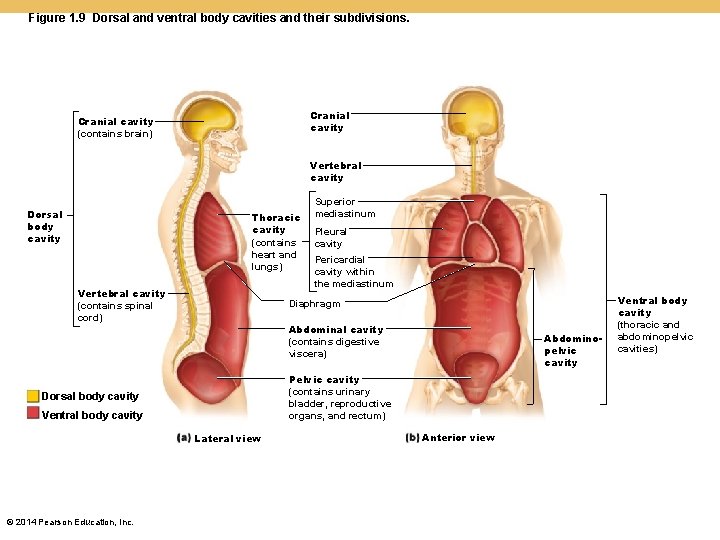
Figure 1. 9 Dorsal and ventral body cavities and their subdivisions. Cranial cavity (contains encephalon) Vertebral crenel Dorsal body cavity Thoracic crenel (contains heart and lungs) Vertebral crenel (contains spinal cord) Pleural cavity Pericardial crenel within the mediastinum Diaphragm Intestinal cavity (contains digestive viscera) Abdominopelvic cavity Pelvic crenel (contains urinary bladder, reproductive organs, and rectum) Dorsal torso crenel Ventral body cavity Lateral view © 2014 Pearson Teaching, Inc. Superior mediastinum Anterior view Ventral body cavity (thoracic and abdominopelvic cavities)

Membranes in Ventral Torso Cavity • Serous membrane or serosa • Thin, double-layered membranes • Parietal serosa lines internal trunk crenel walls • Visceral serosa covers internal organs (viscera) • Layers separated past slit-like crenel filled with serous fluid • Fluid secreted by both layers of membrane © 2014 Pearson Education, Inc.

Serous Membranes • Named for specific crenel and organs with which associated • Each has parietal and visceral layers • Pericardium • Centre • Pleurae • Lungs • Peritoneum • Abdominopelvic crenel © 2014 Pearson Education, Inc.

Figure 1. 10 Serous membrane relationships. Outer balloon wall (comparable to parietal serosa) Air (comparable to serous cavity) Inner balloon wall (comparable to visceral serosa) A fist thrust into a flaccid balloon demonstrates the relationship between the parietal and visceral serous membrane layers. Centre Parietal pericardium Pericardial space with serous fluid Visceral pericardium The serosae associated with the eye. © 2014 Pearson Education, Inc.

Effigy 1. 11 The four abdominopelvic quadrants. Abdominopelvic Quadrants Right upper quadrant (RUQ) Left upper quadrant (LUQ) Correct lower quadrant (RLQ) Left lower quadrant (LLQ) © 2014 Pearson Didactics, Inc.

Figure one. 12 The nine abdominopelvic regions. Abdominopelvic Regions Right hypochondriac region Correct lumbar region Right iliac (inguinal) region Epigastric region Umbilical region Hypogastric (pubic) region Left hypochondriac region Left lumbar region Left iliac (inguinal) region Nine regions delineated by four planes © 2014 Pearson Instruction, Inc. Diaphragm Liver Spleen Gallbladder Stomach Ascending colon of large intestine Transverse colon of large intestine Small intestine Descending colon of large intestine Cecum Appendix Initial role of sigmoid colon Urinary bladder Anterior view of the 9 regions showing the superficial organs

Other Trunk Cavities • Exposed to surroundings • Oral and digestive cavities • Nasal cavity • Orbital cavities • Heart ear cavities • Not exposed to surround • Synovial cavities © 2014 Pearson Didactics, Inc.

Pivot the Tail on the Abdominopelvic Regions • Draw and characterization an image of the Abdominopelvic Regions/Quadrants • Using vocabulary, "pin the tail" on the right region. © 2014 Pearson Educational activity, Inc.

Where to Pin the Tail…. 1. Pin the tail on the about medial, superior quadrant 2. Pivot the tail on the correct lateral, inferior quadrant 3. Pivot the tail on the right upper quadrant 4. Pivot the tail on the left lower quadrant 5. Pivot the tail on the umbilical region © 2014 Pearson Teaching, Inc.

Independent Practice • If yous wanted to dissever thoracic crenel from the abdominal crenel of a cadaver, which type of section would you lot make? • Of the spinal cord, small intestine, uterus, and eye, which are in the dorsal body crenel? • Joe went to the ER complaining of severe hurting in the lower right quadrant of his abdomen. What might be his problem? © 2014 Pearson Pedagogy, Inc.
hatcherhiserfuld1949.blogspot.com
Source: https://slidetodoc.com/chapter-1-the-human-body-an-orientation-anatomy/
0 Response to "Anatomy and Physiology Honors Chapter 1 the Human Body an Orientation Review"
Post a Comment